
Comet to be seen
Comet C/2014 Q2 (Lovejoy) has been discovered by Terry Lovejoy on August, 17th 2014. He used 8 inch Schmidt-Cassegrain telescope. The comet was these…


Young and old clusters. And carbon star.
Messier 38 - that is the name of open star cluster in the Auriga constellation. Together with nearby M36 and M37 they are grouped at a distance…
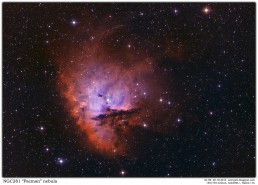
Pacman detected
In the constellation of queen Cassiopeia among Milky Way stars there is one of many H II regions called Pacman Nebula for its resemblance of the…

Elephant in red
Elephant's Trunk nebula is a part of IC1396 complex that contains both open star cluster and surrounding nebulosity. All this goods can be found in…
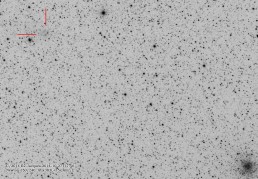
C/2014 E2 Jacques
This comet also currently moves away from Earth. You can see how faint it appears on the picture below (marked with red lines). At the moment the…

C/2011 J2 LINEAR
C/2011 J2 LINEAR is a comet, just another one, not very famous. Discovered in May, 2011 in LINEAR program. It had then apparent brightness of…

Autumn is coming
And northern autumn constellations as well - Cygnus is the one quite well known. I already presented a few pictures positioned in this constellation,…

Hercules globule analyzed
Messier 13 - this is the name of the brightest globular cluster visible in northern hemisphere in constellation Hercules, that is also called…

Serious (black and white) astronomy - SN2014bv
Once I started to be interested in astronomy I believed deep sky tiny galaxies black and white pictures are 'seriuos' ones. I still believe this :)…

Hunting Dogs fuzzies
NGC5033 (lower) and NGC5005 are two galaxies that weakly influence each other gravitionally. The spiral arms of NGC5033 are warped and this is…

SDSS J131123.83+364140.4
I exposed some frames for another galactic field and as usual I inspected them a little trying to find some remote objects. This time besides a few…

Galaxies, galaxies, galaxies...
Galaxy Messier 49 is the most luminous object in the Virgo Galaxy Cluster - its apparent brightness is 8.4mag. It is placed about 56 mln light years…