Some regions of the sky attract attention immediately with bright emission and dramatic shapes. Others reveal their beauty much more slowly. The area around NGC 1333 belongs to the second group: at first glance, it is a small blue reflection nebula, but a deeper exposure shows that it is only the brightest window in an enormous landscape of interstellar dust. Dark filaments, faint brown clouds, blue and yellow reflections, and tiny red shock fronts all overlap in one field. ✨
I had wanted to photograph this region for a long time, ever since I first saw deep images of the Perseus molecular cloud. What stopped me was my suburban sky. Dusty broadband targets are not forgiving: light pollution and sky gradients compete directly with the faint signal, and even a small loss of transparency can erase the most delicate structures. Eventually, I decided to try, and during several January nights I collected more than thirteen hours of LRGB data.
The conditions were far from ideal for such a target. The sky brightness was around SQM 19.5, transparency ranged from average to good, and snow on the ground reflected every nearby light source. On some nights, a faint auroral glow added another gradient to the background. The final result is not exactly what I had imagined, but the sensitive monochrome camera still reached surprisingly deep for these conditions and revealed much more dust than I expected.
NGC 1333 lies in the western part of the Perseus molecular cloud, close to the southern edge of the Perseus constellation, at a distance of about 960 light-years. It was discovered by German astronomer Eduard Schönfeld on the last day of 1855. In visible light, we mainly see reflected starlight, especially the characteristic blue glow around the brighter young stars. The dust itself does not produce this blue light: small grains scatter shorter wavelengths more efficiently, turning an otherwise dark cloud into a reflection nebula.
The bright visible nebula is only the surface of a much larger and extremely young stellar nursery. Behind the obscuring dust are several hundred forming and recently formed stars. Infrared observations are particularly useful here because infrared radiation penetrates the cloud much better than visible light. A Spitzer study identified 137 young members through their infrared excess: 39 protostars and 98 more evolved pre-main-sequence stars surrounded by disks. Many of these systems are still collecting material from their surroundings, and some may already be building future planetary systems.
Star formation in NGC 1333 is not a peaceful process. Young stars eject narrow jets and broader outflows that collide with the surrounding gas. These collisions produce Herbig-Haro objects: small glowing knots and arcs created by shock waves. Some of the reddish details near the nebula are related to this activity rather than to a large, classical hydrogen-emission region. The famous HH 7-11 chain is associated with the young binary system SVS 13, one of the best-known objects embedded in NGC 1333.
A recent study made SVS 13 even more interesting. High-resolution ALMA observations revealed more than 400 nested molecular rings in its jet. These thin, bow-shaped structures move at speeds reaching roughly 100 kilometres per second and act like time stamps of earlier eruptions. The youngest structures could be connected with a bright outburst observed in the early 1990s. In other words, the jet preserves a record of the irregular way in which a newborn star accretes and ejects matter, rather like tree rings recording its turbulent childhood.
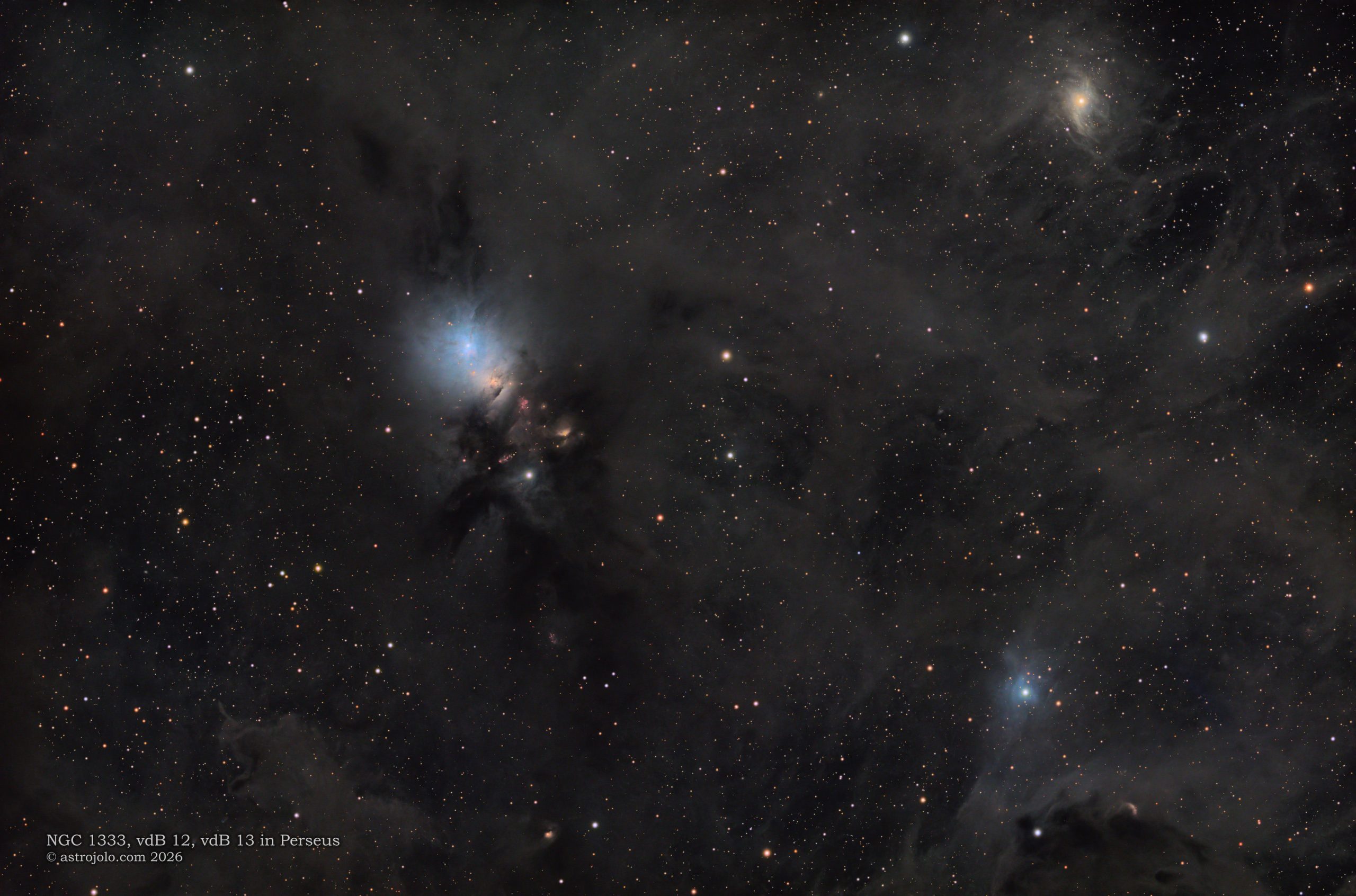
Two smaller reflection nebulae, vdB 12 and vdB 13, add colour variety to the field. They are entries in the van den Bergh catalogue of reflection nebulae and are projected against the dusty outskirts of the Perseus cloud complex.
vdB 12 is illuminated by HD 21110, a cool K-type giant, so its light is noticeably warmer and more yellowish than the usual blue reflection nebulosity. vdB 13, in contrast, is illuminated by the hot B8-type star HIP 15984 and shows a distinctly blue glow. Their different colours are a good reminder that a reflection nebula acts like a cosmic screen: its appearance depends not only on the dust, but also on the spectrum and position of the illuminating star.
This is what makes the whole frame so fascinating. NGC 1333 is the active, chaotic centre, while vdB 12 and vdB 13 are quieter patches of dust caught in nearby starlight. Between them stretch dark clouds with no sharp boundaries, only gradual changes in density and illumination. The visible nebulae are therefore not isolated objects floating in empty space, but highlighted fragments of one much larger molecular environment.
🔭 Photographing such a field from a suburban location is an exercise in patience. The bright core of NGC 1333 appears relatively quickly, but the surrounding dust requires long integration, careful gradient removal, and restrained processing. Push too little and the cloud disappears; push too far and noise or colour blotches begin to imitate real structures.
Despite the difficult winter conditions, I am glad I finally pointed the telescope here. The image may not show every faint filament hidden in the Perseus cloud, but it captures the contrast that fascinated me from the beginning: dark, cold dust surrounding places where new stars are being born.
Image technical data:

Date: January 2026
Location: Nieborowice, Poland
Telescope: TS Photoline 130/910
Corrector: TS FF/FR 0.8x
Camera: QHY268M
Mount: EQ6
Guiding: ASI290MM + Evoguide ED50
Exposures: LRGB 480:120:100:100
Conditions: Bortle 6, transparency and seeing medium-good