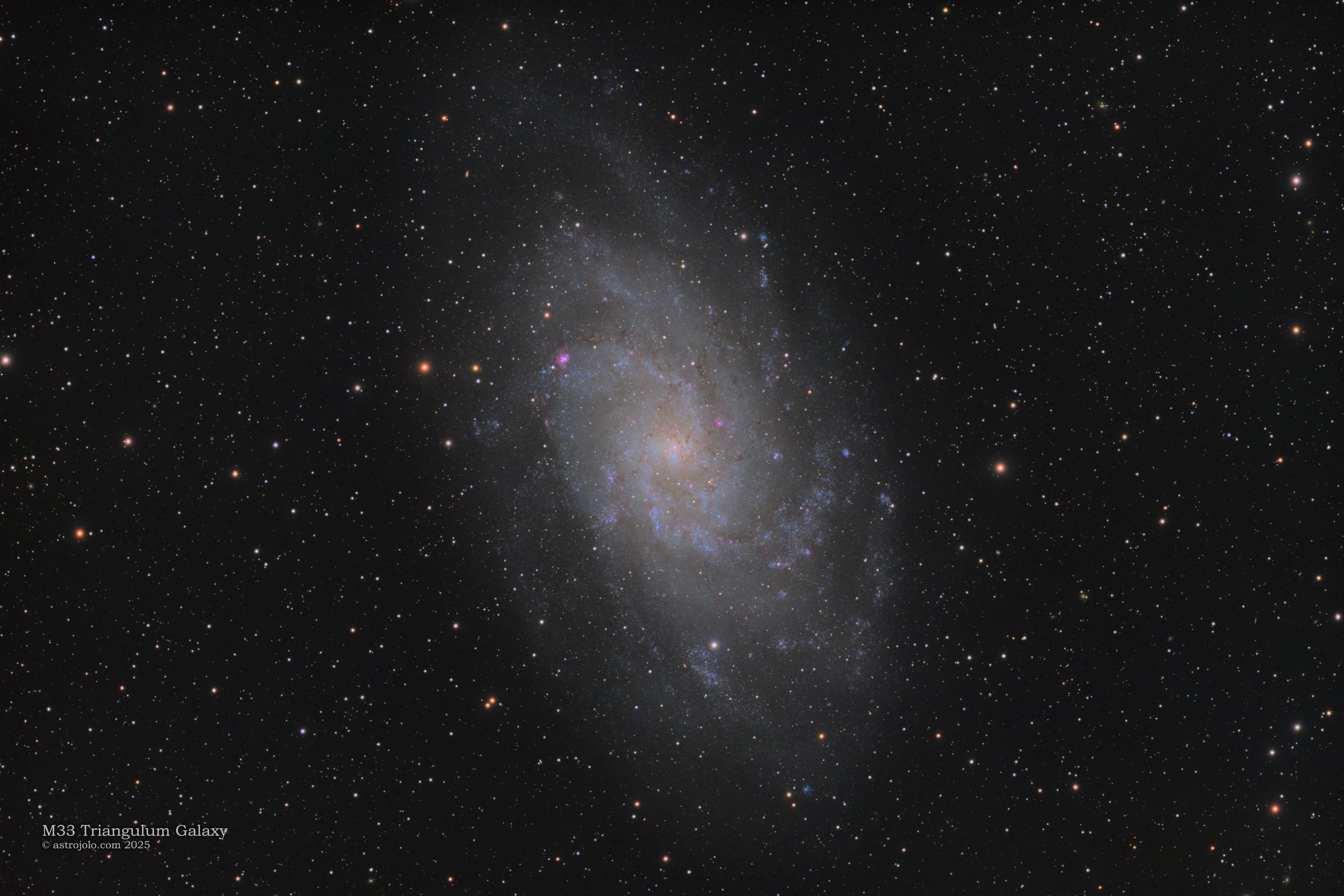
Messier 33 galaxy in the constellation of Triangulum is a spiral galaxy located about 2.9 million light-years from Earth. It belongs to the Local Group of galaxies, and it is the third-largest member behind the Andromeda Galaxy and the Milky Way. Under exceptionally good viewing conditions with no light pollution present, after full dark adaptation, the Triangulum Galaxy can be seen by some people with the naked eye only.
M33 was probably discovered by the Italian astronomer Giovanni Battista Hodierna before 1654. Independently, this galaxy was discovered by Charles Messier on the night of August 25-26, 1764, and it was published in his Catalog of Nebulae and Star Clusters (1771) as object number 33; hence the symbol M33. 20 years later, William Herschel also observed M33, and additionally, he catalogued the Triangulum Galaxy’s brightest and largest H II region separately from the galaxy itself. This nebula eventually obtained the NGC604 symbol. It is one of the largest H II regions known, with a diameter of 1,500 light-years – about 40 times larger that famous Orion Nebula.
M33 is linked to the M31 Andromeda galaxy by several streams of neutral hydrogen and stars, which suggests that a past interaction between these two galaxies took place a few billion years ago. And a more violent encounter will occur 2.5 billion years in the future.
The nucleus of M33 is an H II region and contains an ultraluminous X-ray source – the most luminous X-ray source in the Local Group of galaxies. However, the nucleus does not appear to contain a supermassive black hole, as the mass in the center is significantly lower than the mass expected from the disk kinematics models.
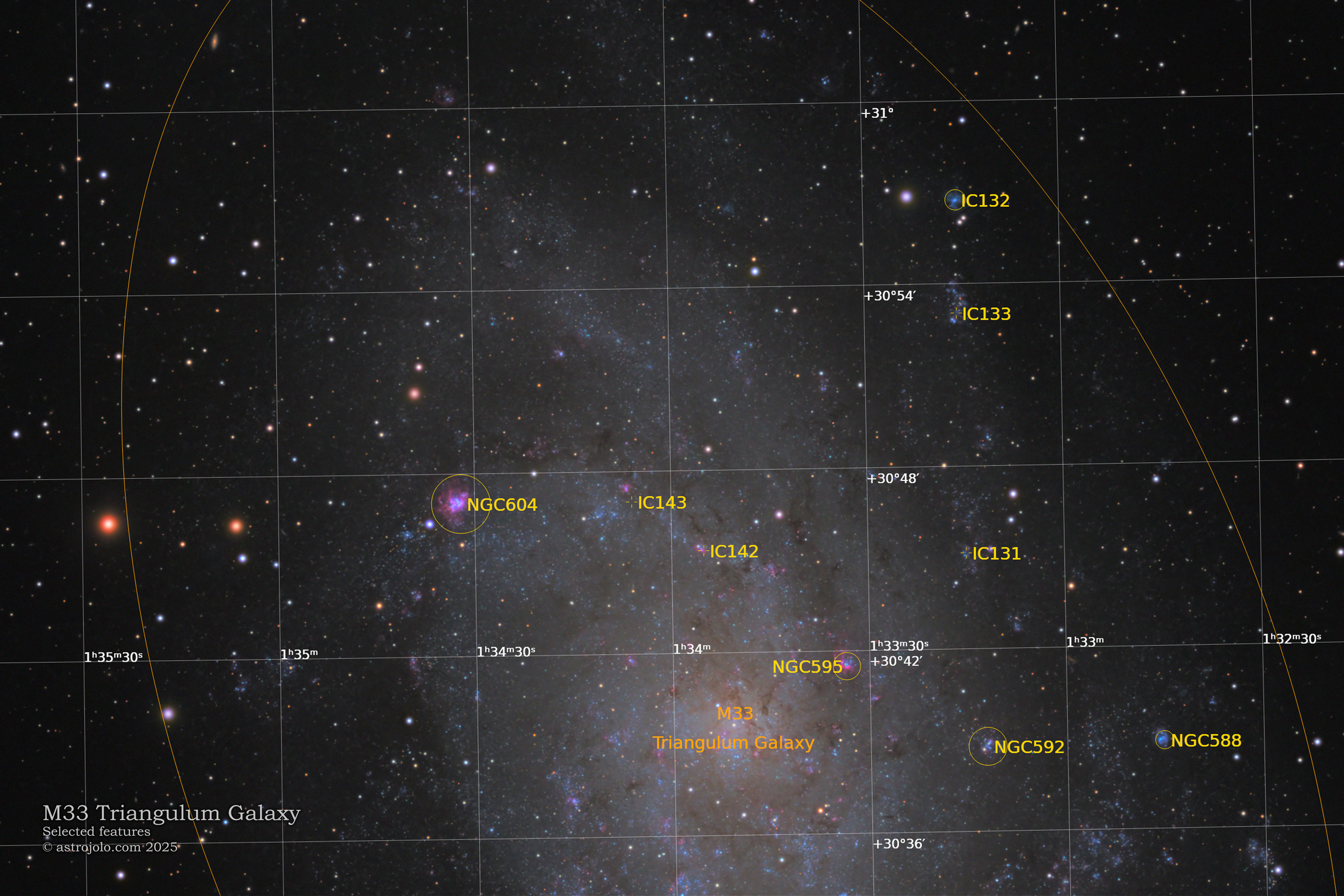
I have imaged M33 several times already – also with a 130mm refractor, but a different camera then. This time, the conditions were promising (as for my suburban location) – both seeing and transparency were good. I decided not to collect any additional H alpha signal to embed into the RGB data. I wanted to create a calm and natural image without dramatic hydrogen bells and whistles.
Despite only RGB data, the HII regions are clearly visible, and it is also easy to notice some of them are crimson red, while some others are evidently blue. These kinds of nuances are often lost when combining RGB data with the H alpha channel.
Image technical data:

Date: November/December 2025
Location: Nieborowice, Poland
Telescope: TS Photoline 130/910
Corrector: TS FF/FR 0.8x
Camera: QHY268M
Mount: EQ6
Guiding: ASI290MM + Evoguide ED50
Exposures: LRGB 280:40:40:40 minutes
Conditions: Bortle 6, transparency and seeing good